Keep the Scar

Sarah Kendzior recently penned a must-read newsletter essay on Substack entitled Quicksand: Gen X was right after all. I am not of the X generation but do have two adult children who are.
I keep thinking about her reference to the scars we incur and endure as human beings. Not as metaphor first, but as fact with the raised line on a knuckle, the faded mark on a knee, the thing you can press a finger against and remember exactly where you were when it happened. A scar is proof. Even when we look at the geographic landscapes across the globe we see the physical scars, like the Grand Canyon or the Indus River Gorge in Pakistan or the Dead Sea Transform or the Great Rift Valley of Africa. These scars have a history. It says this occurred to this body, on this Earth, at this time, and nothing can talk it back into not having happened.
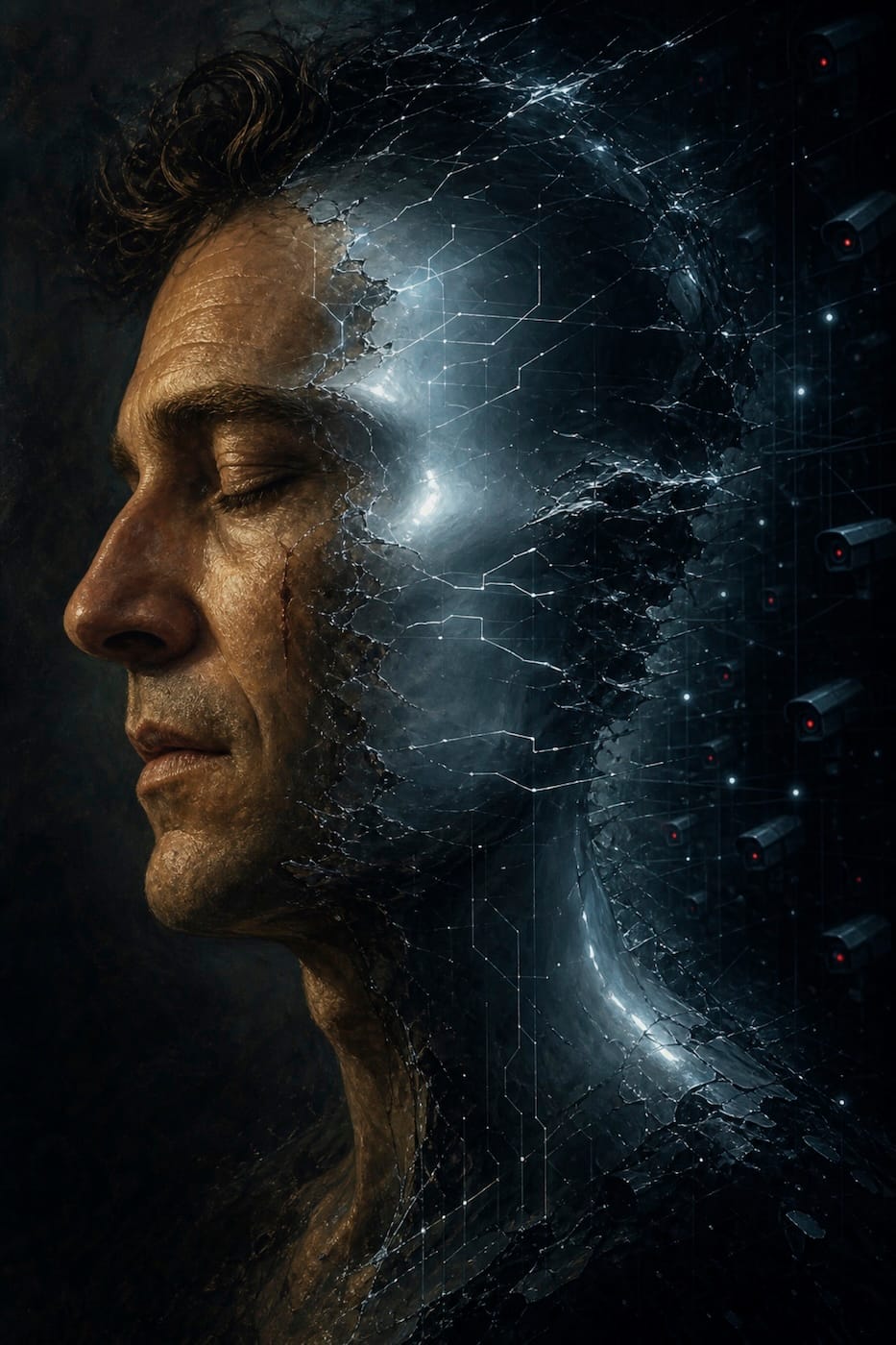
That's the image that won't leave me since I sat with her essay "Quicksand." She writes about the filters that hide faces being made from scars as the "scraped flesh from fellow humans, molded until it's unrecognizable, slick like plastic skin." No record of pain, she says, means no accountability. No ownership of words means no proof. I read that and felt something tighten in my chest, because I recognized the trade she's describing. We are being offered synthetic 'smoothness' in exchange for evidence of having lived as authentic human beings. And an alarming number of us are taking the deal in quiet surrender.
Here's what strikes me as the real insight in Kendzior's piece. Nobody is getting dragged into this. She says people are "giving up on being human. It's too hard." That's not a hostile takeover. That's exhaustion. That's a population made to feel like authenticity is a liability and that showing your actual, unedited, imperfect face online (and as a full-on metaphor for our individual lives) is somehow reckless, while the filtered, poly-synthetic, scrub-maxed version is treated as the responsible, professional and socially safe choice in a society increasingly awash in artificial social stimulation and simulation.
The temptation to let autocomplete finish a sentence, to let the bot post for you, to accept the flattering filter, to let some tool smooth the rough edges off something written because raw honesty takes more out of one than a polished substitute. And I think that's exactly the mechanism Kendzior is naming. The system doesn't need to force anyone into synthetic living, if it can just make authentic living exhausting enough that we opt out on our own. Quicksand doesn't grab you. You walk into it, one small surrender at a time, and by the time you notice you're sinking, you've already stopped struggling.
What's actually being lost in that surrender isn't just privacy. It's traceability. The very thing that makes a life, a claim, a testimony and witness for human living that's believable. If a captcha can decide what counts as human, if a piece of software can "pronounce" a child's essay artificial, then the burden of proof has flipped entirely. We used to assume personhood and ask power to prove wrongdoing. Now ordinary people are asked to prove their own personhood, over and over, to systems that profit from the very ambiguity they create.
This threatens far more than just privacy. I don't think this is really about surveillance cameras or data breaches. At least not primarily. I think it's about meaning and whether a human life continues to live as something that can register as real, remembered, and worth defending.
Meaning has never come from ease. Every serious thinker who has looked honestly at what makes a life worth living keeps landing on the same conclusion. It's forged through struggle, through mortality, through the friction of consequence and choice and not through frictionless, filtered, effortless existence. Kendzior's "scraped flesh" image captures exactly what gets lost when that friction is engineered away. A typical hi-res AI-generated face is smooth because it has had the texture of an actual life sanded off of it. If we keep trading the scarred, difficult, real version of ourselves for the synthetic one because it's easier, we're not just losing authenticity. We're forfeiting the mechanism through which humans have always built meaning and purpose.
There's an economic dimension to this too, and it concerns me more the longer I sit with it. Thinkers warning about AI's disruption of human meaning, point to something like a "useless class" emerging when people are stripped of any function the market still recognizes, because a machine can now do the job faster and without complaint. When contribution and labor stop being the thing that grants a person social value, and machines can also generate the words, the images, and even the appearance of care, what's left to root a person's sense of purpose in? I don't have a clean answer. But I know it can't be outsourced to a system that has every incentive to keep us guessing and create a substitute life for us in a world that is too easily controlled, monitored and manipulated by the abuse and misuse of power and especially when power stops needing to think.
This is where the history I keep returning to as lived memory is starkly unavoidable as it rings with great alarm in my ears. Hannah Arendt sat through Eichmann's trial expecting to find a monster and found, instead, a bureaucrat and someone who displayed no hatred, no ideological fire, only a chilling absence of reflection. He wasn't asking whether what he was doing was right. He was asking whether the paperwork was correct. Arendt called this the banality of evil as atrocity carried out not by villains, but by ordinary people who had simply stopped thinking, who let the system's logic replace their own judgment.
I used to read that and think of it as a relic of a specific historical horror. I don't anymore. Because while Eichmann only needed a bureaucracy of clerks and memos to accomplish, an algorithm now does all by itself, and faster, with fewer human hands required, if at all. When a surveillance system flags a dissident, denies someone a loan, or recommends detention, the person overseeing it can simply say, "the system decided." Responsibility gets diffused across a chain of code and data until nobody, anywhere, can be pinned down as the one who chose. That is Eichmann's defense. I was just following orders. Except now the order-giver is a black box nobody, including its own engineers, can fully explain.
And here is the darkest part, the part I keep circling back to at night. This doesn't require a single evil actor pulling levers with malicious intent. It requires administrators willing to defer judgment to a score they don't understand, technologists willing to ship a tool without asking who gets hurt by it, and a public trained to accept "you were flagged" as an unappealable verdict. Millions of small, deniable, procedurally justified clicks, adding up to a machinery of control more total and more diffuse than anything a single tyrant could have built alone.
I want to be honest about something else, too. The research on this is not uniformly bleak. Even authoritarian regimes wielding AI face real limits through false positives that spark backlash (see the Flock camera pushback), thresholds that must be constantly recalibrated and populations that don't behave as predictably as a training set assumes. A lot of the fear that keeps people compliant isn't proof the system is omniscient. It's a bluff, and bluffs can be called. That matters. It means the outcome isn't sealed. It means the event horizon everyone talks about isn't a law of physics. It's a set of choices, made by people, that other people can still refuse to make and choose a different way.
And yet we are now facing a world increasingly 'futured' by the rise of techno-feudalism removing the analog of an authentic human life that I refuse to give up. I don't think it's an accident that the same technologies dissolving individual accountability are also concentrating ownership of land, water, computation, and attention into fewer hands. Call it what it increasingly resembles. A neo-feudal arrangement, dressed in the language of innovation, where a handful of platforms own the infrastructure everyone else is required to rent access to, just to participate in daily life. You don't own your face anymore once it's scraped into a training set. You don't own your words once a platform can claim, or at least plausibly allege, without proof, that those words were generated rather than written and you are left with proving the negative as the guilted victim. Under those conditions, "ownership" of a life starts to feel like a technicality rather than a fact.
Which is why I've stopped treating analog things as nostalgic indulgences and began treating them as acts of resistance. A print book that doesn't read you back. A handwritten letter with a signature that can't be forged by an autocomplete model without effort and detection. A face without a filter, an unedited photograph, a conversation that isn't being logged for analysis to feed the algorithm stripped of humanity. None of these things are large gestures. But each one is a refusal to make yourself illegible to your own life, and a refusal to let a system profit from an edited version of you that simply isn't true.
Is there an antidote to this depressing dystopia? Arendt's own answer to the banality of evil was disarmingly simple. Thinking. Not cleverness, not credentials but the ongoing, internal habit of asking yourself whether what you're doing is right, and refusing to let an external authority answer that question for you. She said something that has stayed lodged in me for years. There are no dangerous thoughts, as thinking itself is dangerous and also dangerous, that is, to any system that depends on people not asking the hard and uncomfortable questions that challenge the prevailing power narrative and abuse of authority.
I think that's still the foundation, but I don't think it's sufficient on its own anymore, because the systems we're up against now are faster and larger than any individual conscience can monitor alone. So, the antidote must operate on three levels at once, and I want to say plainly what I think each one of them demands, while applying technology and even AI for improving the essential analog existence of life as well as promoting the general welfare and well-being of the people.
Personally, it means refusing the small surrenders. It means keeping the scar. Keeping the unfiltered face. Writing the sentence yourself, badly if necessary, rather than let something else finish it for you. It means reading something that can't track your eye movements. Having a direct, unfiltered human-to-human conversation that isn't optimized for engagement. None of this fixes the larger system, but it keeps you the kind of person capable of noticing when the larger system is no longer sustainable, while living within the system as it is, but not of it, and nurturing the seeds for a whole new future that can emerge beyond the event horizons we face.
Civically, it means insisting, loudly and specifically, that no algorithmic recommendation gets to make a final decision about a human life without a person who can be named, questioned, and held responsible standing behind it. Explainability isn't a technical nicety. It's the precondition for anyone ever able to think about what a system did, and Arendt already told us what happens when nobody can think about what's being done in their name.
Structurally, it means supporting the unglamorous work that includes encrypted tools, digital literacy, restrictions on repressive and contentless surveillance technology driven by a voracious appetite for any and all data, and coalitions willing to set enforceable limits on what power is allowed to automate. It also means refusing to accept the premise that convenience is a good enough reason to hand over one more piece of what makes us traceable, answerable, and real.
We truly face stark choices in front of us. But I don't think the dystopia people fear is a single dramatic event we'll see coming. I think it's already arriving in the form of a thousand small, reasonable sounding trade-offs as we give up more and more of what it means to be human. A filter here, a verification system there, a form that asks you to prove you're human to a machine that has never had to prove anything to you. The event horizon isn't a wall we're about to hit. It's a slope we're already standing on and sliding down as the angle is raised higher and higher, and the only question left is whether we keep slipping down it because it's easier than climbing back up.
So here is what I want to say, plainly, without hedging. Choose the harder thing. Choose the unfiltered face, the handwritten note, the book with a spine that cracks, the conversation that isn't harvested, the decision that gets made by a person who must look you in the eye and answer for it. Choose the frictions of life and those between the lines of our living. Refuse to let "the system decided" become an acceptable sentence in your own life or in the institutions you belong to. Protect your scars, because they are the only proof you were ever here. A species that stops keeping proof of its own suffering and joy is a species that has quietly agreed to stop being believed or believable made up of essential and unique human beings.
This privileged planet and the people on it don't need a perfect technological solution. Our world needs enough of us, a remnant of us, to keep insisting on preserving and protecting and defending the analog, accountable, answerable version of being alive as the intrinsic humanity in all of us with the capacity for moral agency and fundamental choice. Not out of nostalgia, but because it is the only version that has ever actually produced meaning, and the only version, if we are honest with ourselves, that keeps power honest enough to be worth living under and also hold it to account when it doesn't. That insistence, small and unglamorous as it looks from the outside, is the whole of the everyday resistance we have left, while also getting outside and experiencing the natural reality of the world, including all of its scars, but also its sublime beauty. In truth, we are all part of one human family and each of us has inalienable rights and agency. It is enough to start with. It has to be.